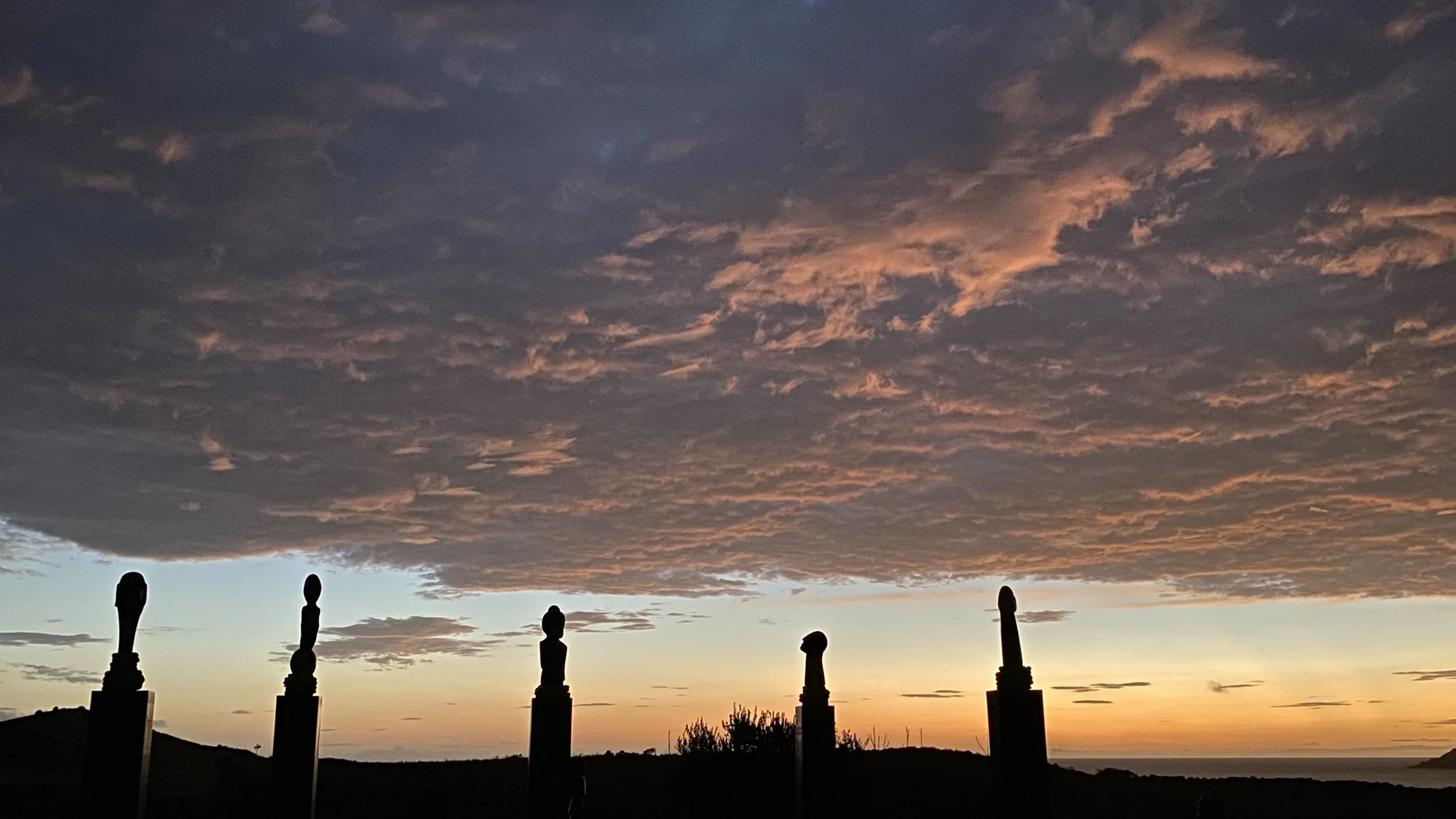
Council of Ancestors
This body of work assembles a council of ancestral figures drawn from across the Pacific, positioned in deliberation rather than ceremony. Each figure represents a distinct relationship to ocean, land, and environment — shaped by geography, cultural practice, and inherited knowledge. Together, they form a collective space of discussion, where perspectives converge without resolving into a single voice.
Each ancestor is paired with a pou bearing visual languages specific to their region. Motifs of seabirds, navigation, fishing tools, and landforms articulate lived relationships to place, surfacing environmental knowledge as something carried, marked, and held rather than spoken. These references operate as identifiers, situating each figure within a wider oceanic network of interdependence.
The council is intentionally non-uniform. Expressions differ; gazes do not align. Some figures face inward, others turn away. This dissonance acknowledges the reality of environmental discourse — that responsibility, urgency, and understanding are experienced unevenly across regions, histories, and conditions. The work resists consensus, allowing disagreement and tension to remain visible.
Rather than offering instruction or resolution, the council holds space for collective reckoning. Ancestral presence is positioned not as a source of answers, but as a framework through which contemporary environmental responsibility might be reconsidered — as stewardship shaped through dialogue, restraint, and relational care across the Pacific.
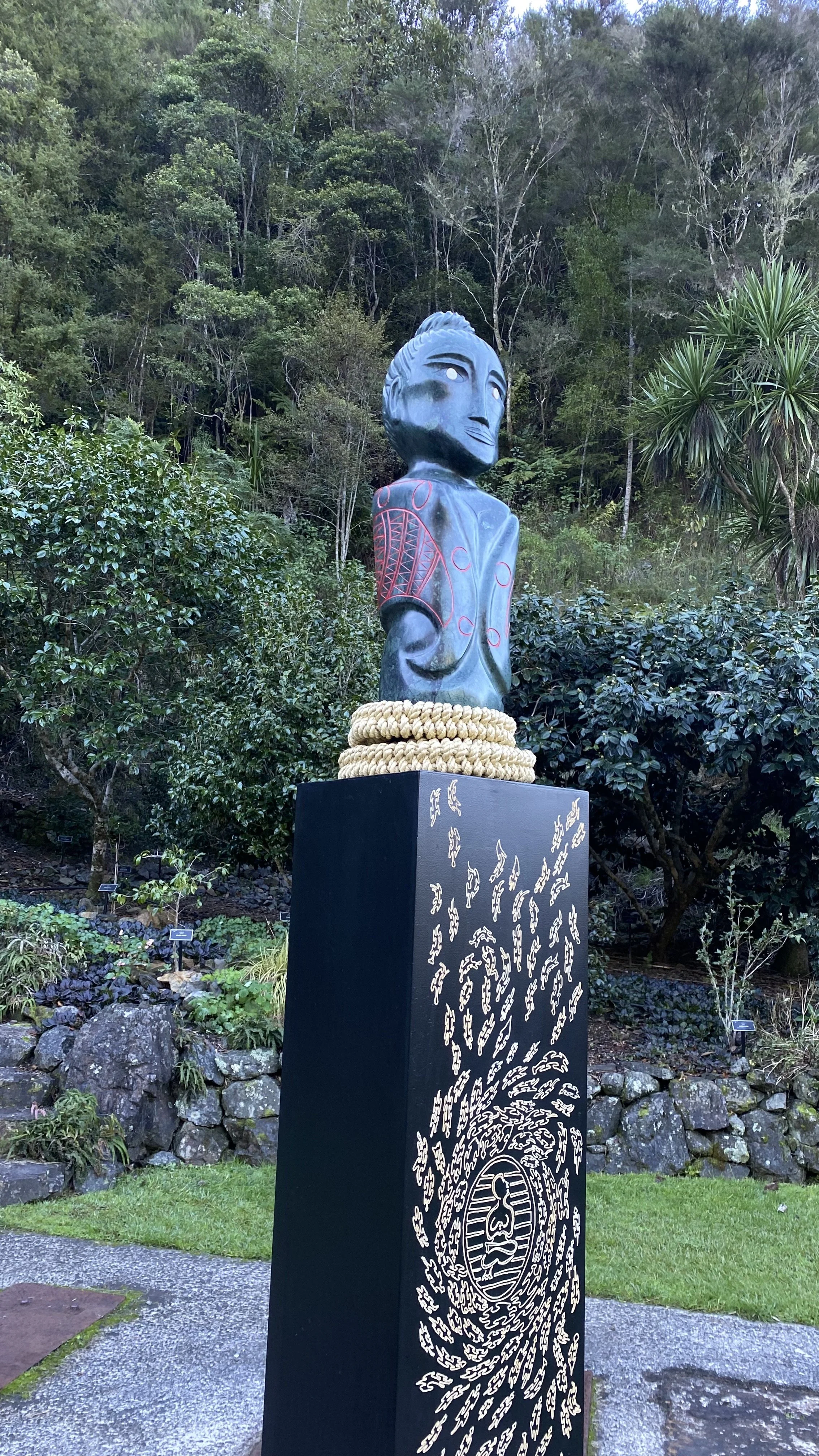
Cloaked Chief
Serpentine, treated timber, rope, shell, acrylic, oil-based paint, steel pin
2300 × 400 × 400 mm
Cloaked Chief presents a figure of composure and authority, its stance held in stillness rather than gesture. The engraved mantle carries a layered visual language — manta ray and frigate bird motifs interwoven with pattern, lineage markers, and references to landform — forming a surface that operates as both adornment and archive.
The pou functions as a vertical narrative structure, situating the figure within a cosmological framework of emergence and continuity. Together, figure and support propose a reading of leadership not as dominance, but as bearing: a holding of ancestral knowledge, cultural memory, and collective presence across time.
Chief in Reverence

2023
Black granite, serpentine, serpentinite, treated timber, rope, shell, coral, copper, oil-based paint, steel pin
2300 × 400 × 400 mm
Chief in Reverence positions the figure within a posture of acknowledgment rather than command. The stance suggests attentiveness — a moment of pause shaped by inherited relationships to land and ocean systems historically defined by abundance.
That abundance, once sustained through reciprocal practices of care and restraint, is now increasingly fragile. Pressures such as over-extraction, coral degradation, and intensifying storm patterns register not as narrative content, but as the conditions under which the figure stands.
Reverence here operates as an active orientation rather than a symbolic gesture. The figure holds gratitude alongside awareness, situating stewardship as a practice shaped by memory, responsibility, and continued dependence on the ecological vitality of Pacific environments.
Masked Ancestor
2023
Andesite, agate, treated timber, rope, oil-based paint, steel pin
2300 × 400 × 400 mm
This figure draws from Solomon Islands visual traditions, positioning the mask as a site of resolve rather than ornament. The expression is held in tension — neither confrontational nor passive — registering discontent alongside endurance.
Situated within an open grassland, the figure is aligned explicitly with land rather than territory. The ground operates as a unifying plane, extending the figure’s presence beyond regional specificity toward a broader West Pacific context. Here, land is not framed as backdrop, but as a shared condition — continuous, sustaining, and implicated in the collective futures the council gathers to consider.
The One Who Stands Between
2023
Andesite, treated timber, rope, oil-based paint, steel pin
2300 × 400 × 400 mm
The One Who Stands Between occupies a mediating position between land, body, and sky. Engraved mountain forms and a solar motif articulate the anterior surface, establishing a vertical axis that links terrain and celestial orientation. Along the posterior, a continuous braided form traces lineage as movement — a passage carried rather than fixed.
The figure does not assert identity through place or tradition, but through alignment. Standing neither as guardian nor authority, it functions as a threshold: a presence situated between elevation and grounding, inheritance and continuity. Strength is conveyed through stillness, and connection through sustained relationship rather than declaration.
Here, ancestry is framed not as origin alone, but as an ongoing condition — held between what has been carried forward and what remains to be tended.

Rapa Nui Ancestor
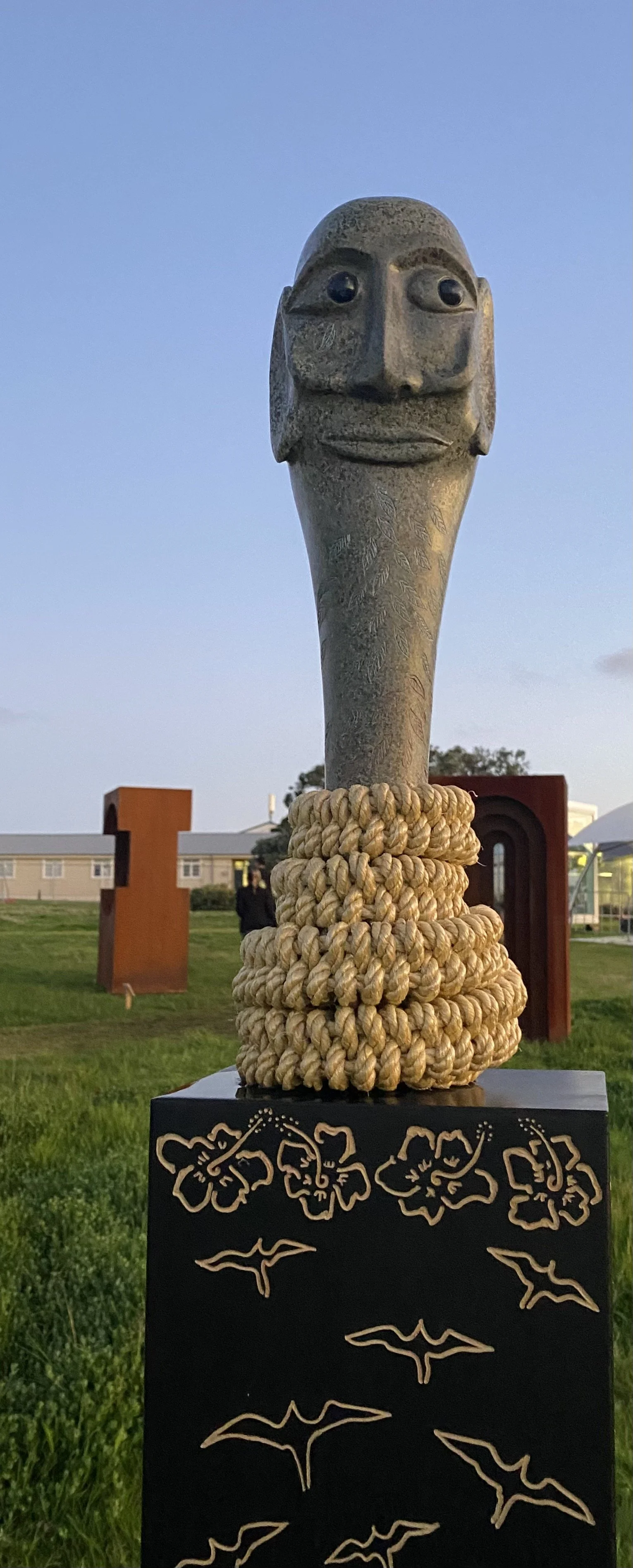
2023
Andesite, pounamu, treated timber, rope, acrylic and oil-based paint, steel pin
2300 × 400 × 400 mm
Rapa Nui Ancestor draws from lesser-known ancestral forms distinct from the monumental moai, positioning the figure within a more fragile, corporeal register. The body is rendered with a cadaverous restraint, emphasising vulnerability over monumentality and resisting the dominance of familiar iconography.
Engraved leaf forms register across the surface as traces of loss rather than ornament. Some are incised in recession rather than relief, carved inward to suggest absence — erosion rather than accumulation. Several leaves descend as tears, allowing environmental degradation to surface through form without narrative declaration.
The figure’s gaze is held laterally, neither confrontational nor withdrawn, suggesting contemplation shaped by responsibility rather than judgement. The pou beneath carries frigate bird imagery referencing the Tangata Manu tradition — a system of ritual competition and resource control centred on the sooty tern egg. Here, that history operates as context rather than explanation, situating the figure within a legacy where environmental conditions and cultural structures are inseparable.
Rather than illustrating collapse, the work holds tension between endurance and depletion. Environmental crisis and cultural memory are not resolved, but remain co-present — carried forward through material, incision, and restraint.
The ‘Council’ gathered around the talking stick.
2023
Black granite, acrylic paint
1100 × 90 × 100 mm
Talking Stick functions as a central instrument within the council — a device that structures exchange rather than authority. Rather than designating power, it establishes sequence, presence, and attentiveness, allowing each voice within the council to emerge in turn.
The form is articulated through a vertical progression of elements. A navigational compass crowns the upper register, positioning orientation and guidance as collective rather than directional. Angular forms along the upper section draw from architectural rooflines and pou, introducing a vocabulary of shelter and support. The central band carries marine imagery — fish, rays, and plankton — situating the discussion within oceanic systems that sustain and connect Pacific regions.
The lower section resolves into a squared foundation, referencing structural posts and grounded stability. Here, motifs of birds, spears, mountains, and shark teeth vary across surfaces, tracing regional distinctions while maintaining continuity within the whole. These elements do not function as illustration, but as markers of relationship — between land, sea, tools, and inherited knowledge.
Within the Council of Ancestors, the talking stick does not speak for the figures. Instead, it holds the conditions for dialogue — reinforcing the council as a space of listening, exchange, and negotiated responsibility rather than consensus or command.
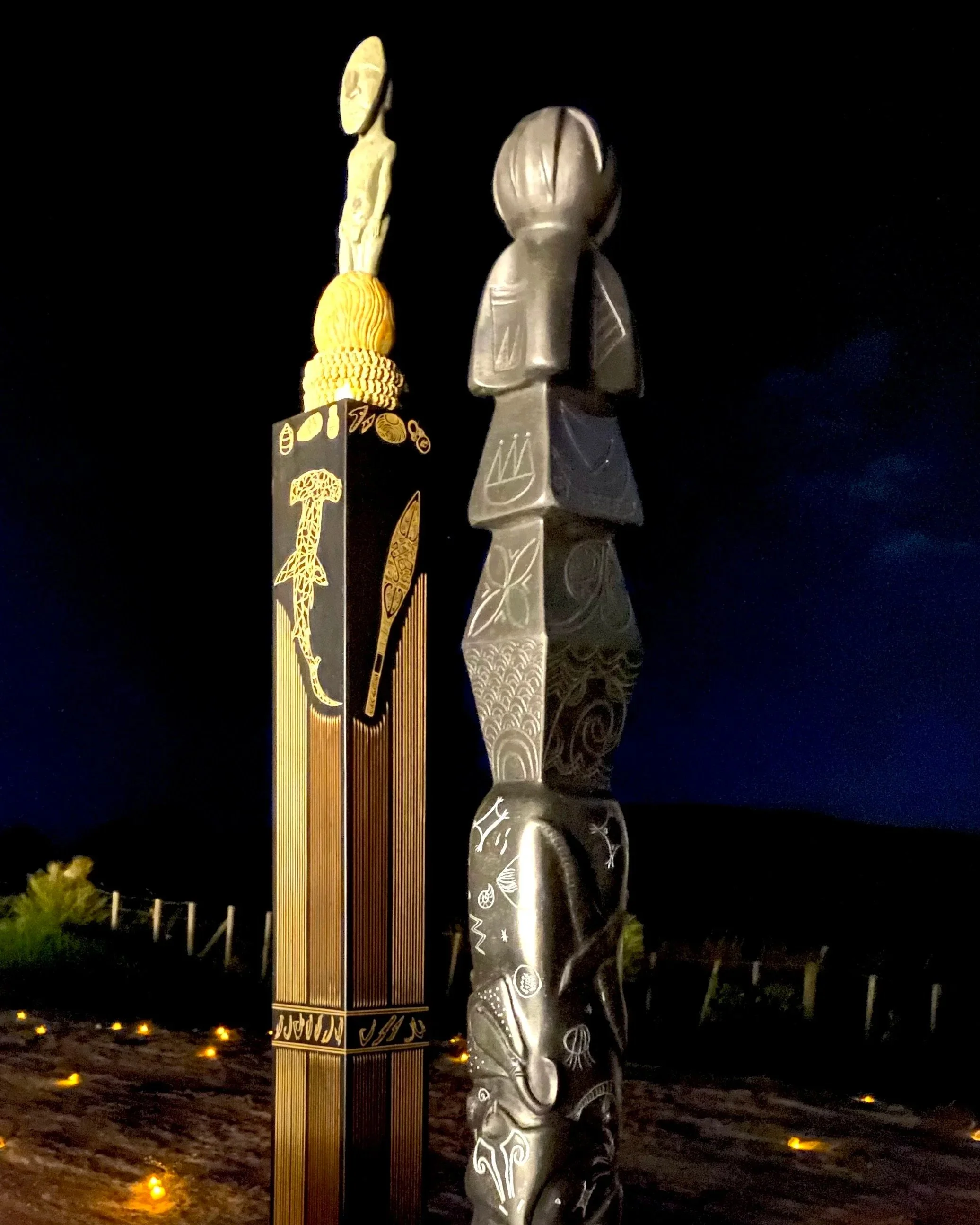
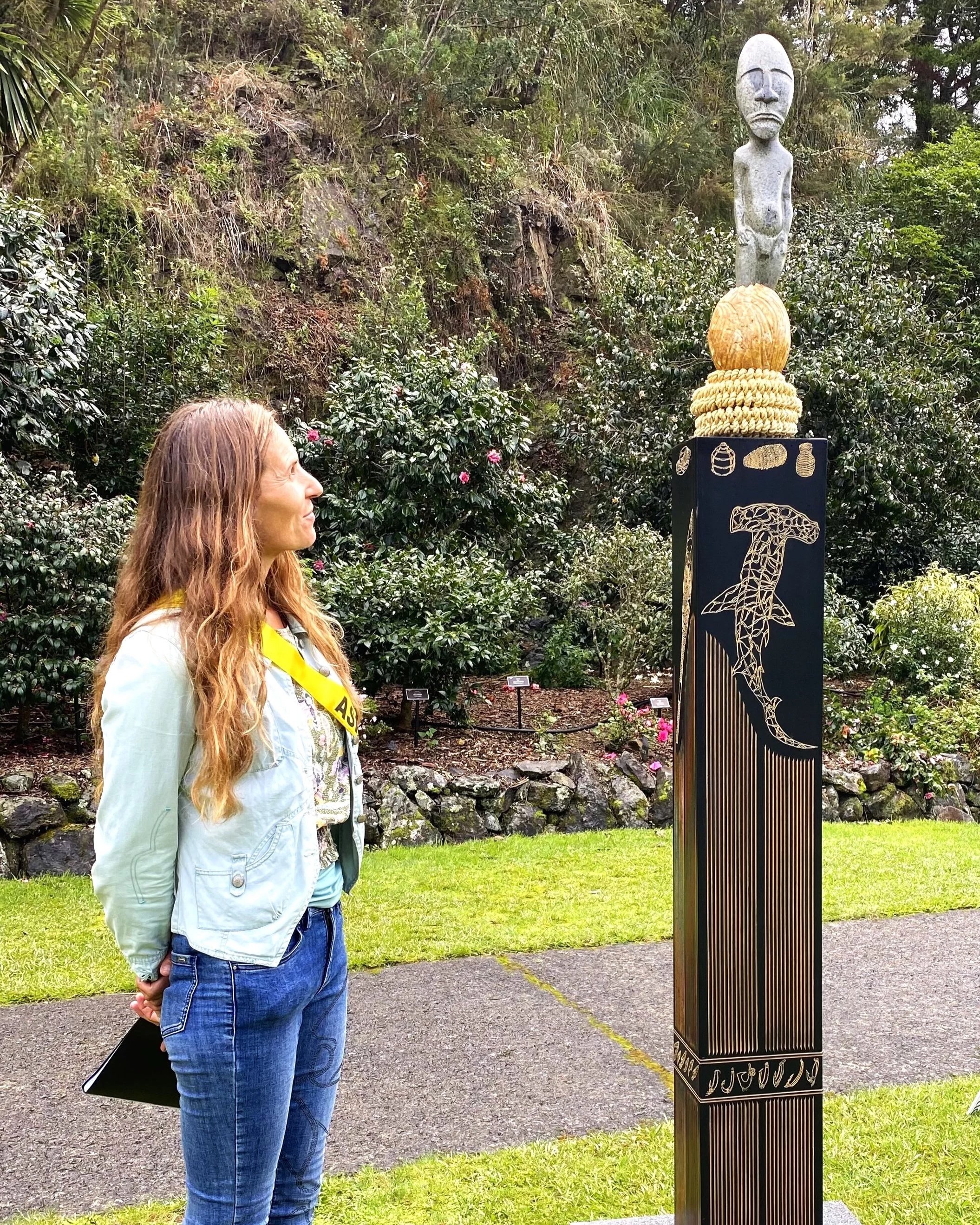
Cook Islands Ancestor

2023
Andesite, treated timber, rope, oil-based paint, steel pin
2300 × 400 × 400 mm
Cook Islands Ancestor is positioned through the pou as a record of ocean-based knowledge. Motifs of sharks, hooks, fish traps, and paddles articulate a relationship to fishing, navigation, and sustained engagement with the sea.
These elements do not narrate a single history, but register practice — tools and species held as markers of inherited expertise. Within the council, the figure contributes a perspective shaped by oceanic labour, resource dependence, and long-standing systems of reciprocity between human presence and marine life.